InterSCellar#


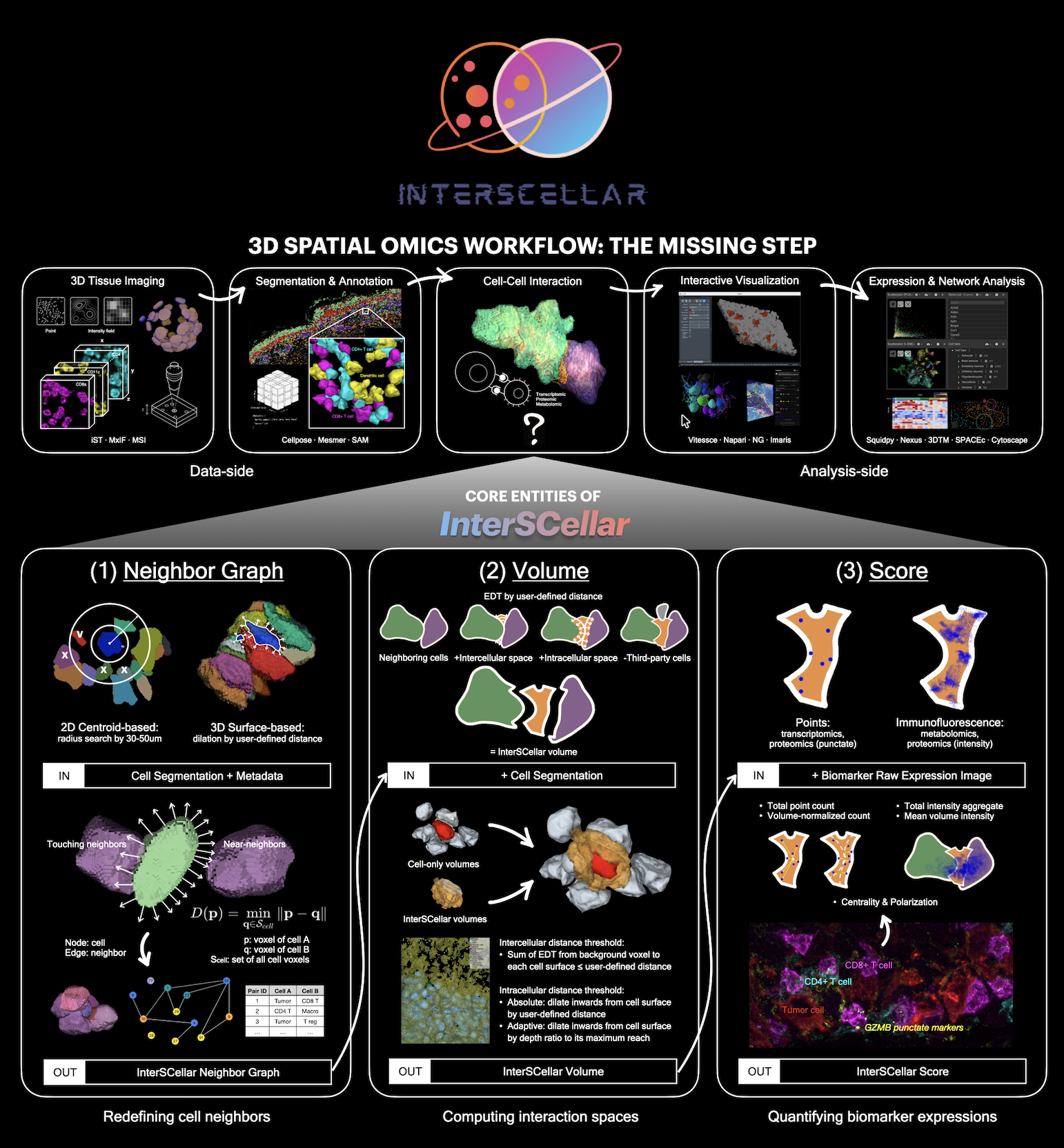
InterSCellar is a Python package for surface-Based cell neighborhood and interaction volume analysis in 3D spatial omics.
Installation#
Install package:
pip install interscellar
Usage#
Import:
import interscellar
3D Pipeline:#
(1) Neighbor Graph: Cell Neighbor Detection & Graph Construction
neighbors_3d, adata, conn = interscellar.find_cell_neighbors_3d(
    ome_zarr_path="data/segmentation.zarr",
    metadata_csv_path="data/cell_metadata.csv",
    max_distance_um=0.5,
    voxel_size_um=(0.56, 0.28, 0.28),
    db_path="results/sample_neighbor_graph.db",
    output_csv="results/sample_neighbors_3d.csv",
    n_jobs=8
)
(2) Volume: Interscellar Volume Computation
(a) Absolute: dilates inwards from the cell surface by a fixed, user-defined distance.
# Interscellar volumes
volumes_3d, adata, conn = interscellar.compute_interscellar_volumes_3d(
    ome_zarr_path="data/segmentation.zarr",
    neighbor_pairs_csv="results/sample_neighbors_3d.csv",
    neighbor_db_path="results/sample_neighbor_graph.db",
    voxel_size_um=(0.56, 0.28, 0.28),
    max_distance_um=3.0,
    intracellular_threshold_um=1.0,
    n_jobs=8
)
(b) Adaptive: dilates inwards from the cell surface by a depth ratio relative to the cell's maximum reach.
# Interscellar volumes
volumes_3d = interscellar.compute_interscellar_volumes_3d_adaptive(
    ome_zarr_path="data/segmentation.zarr",
    neighbor_pairs_csv="results/sample_neighbors_3d.csv",
    voxel_size_um=(0.56, 0.28, 0.28),
    max_distance_um=3.0,
    rho_threshold=0.5,
    n_jobs=8
)
Cell-only volumes
# Cell segmentation with the interscellar volumes removed
cellonly_3d = interscellar.compute_cell_only_volumes_3d(
    ome_zarr_path="data/segmentation.zarr",
    interscellar_volumes_zarr="results/sample_adaptive_interscellar_volumes.zarr"
)
(3) Score: Biomarker Quantification in Interscellar Volumes
# Points (transcriptomics, punctate proteomics): centrality score
scores_3d = interscellar.calculate_interscellar_scores_3d(
    interscellar_volumes_zarr="results/sample_adaptive_interscellar_volumes.zarr",
    spot_zarrs={"GZMB": "data/GZMB_spots.zarr"},
    n_jobs=8
)
# Immunofluorescence (metabolomics, intensity proteomics): intensity statistics
python -m interscellar.core.calculate_interscellar_scores_3d_intensity \
  --segmentation-zarr "results/sample_adaptive_interscellar_volumes.zarr" \
  --raw-expression-zarr "data/raw_expression.zarr" \
  --n-jobs 8
2D Pipeline:#
(1) Neighbor Graph: Cell Neighbor Detection & Graph Construction
neighbors_2d, adata, conn = interscellar.find_cell_neighbors_2d(
    polygon_json_path="data/cell_polygons.json",
    metadata_csv_path="data/cell_metadata.csv",
    max_distance_um=1.0,
    pixel_size_um=0.1085,
    n_jobs=8
)
Utilities:#
Preprocessing
# Find cells truncated at the top/bottom Z-edge of the volume
exclude-truncated \
  --segmentation-zarr "data/segmentation.zarr" \
  --buffer-voxel-min 5 \
  --buffer-voxel-max 5
# Split the segmentation into included vs. excluded cells and view them (Napari)
visualize-excluded-3d \
  --segmentation-zarr "data/segmentation.zarr" \
  --excluded-ids "data/segmentation_z_edge_excluded_cells.txt"
# Remove nuclei from any label volume (interscellar, cell-only, or cell segmentation)
exclude-nuclei \
  --input-zarr "results/sample_adaptive_interscellar_volumes.zarr" \
  --nuclei-segmentation-zarr "data/nuclei_segmentation.zarr"
Volume Processing
# Merge cell-only and interscellar volumes into one label zarr
combine-volumes-3d \
  --cell-only-zarr "results/sample_adaptive_cell_only_volumes.zarr" \
  --interscellar-zarr "results/sample_adaptive_interscellar_volumes.zarr"
# XYZ centroids (um) of each interscellar volume
interscellar-centroids-3d \
  --combined-zarr "results/sample_adaptive_combined_volumes.zarr"
# Cell-only volumes for a single pair (removes only that pair's interscellar volume)
cell-only-pair-3d \
  --cell-segmentation-zarr "data/segmentation.zarr" \
  --interscellar-zarr "results/sample_adaptive_interscellar_volumes.zarr" \
  --pair-id 123
Feature Extraction
# Per-volume expression features
feature-extract-3d \
  --segmentation-zarr "results/sample_adaptive_interscellar_volumes.zarr" \
  --raw-expression-zarr "data/raw_expression.zarr" \
  --output-csv "results/features_3d.csv"
# Spot counts per volume from a spot coordinate CSV
spot-count-3d \
  --combined-zarr "results/sample_adaptive_combined_volumes.zarr" \
  --metadata-csv "results/volume_metadata.csv" \
  --spots-csv "data/GZMB_spots.csv" \
  --biomarker GZMB
Volume Visualization
# Full dataset (Napari)
visualize-all-3d \
  --cell-only-zarr "results/sample_adaptive_cell_only_volumes.zarr" \
  --interscellar-zarr "results/sample_adaptive_interscellar_volumes.zarr" \
  --cell-only-opacity 0.7 \
  --interscellar-opacity 0.9
# Single pair (Napari)
visualize-pair-3d \
  --pair-id 123 \
  --cell-only-zarr "results/sample_absolute_cell_only_volumes.zarr" \
  --interscellar-zarr "results/sample_absolute_interscellar_volumes.zarr" \
  --pair-opacity 0.6 \
  --cells-opacity 0.7
# Single pair from the adaptive pathway, including voxels shared with other pairs (Napari)
visualize-pair-3d-adaptive \
  --pair-id 123 \
  --interscellar-zarr "results/sample_adaptive_interscellar_volumes.zarr" \
  --mask "data/segmentation.zarr" \
  --show-overlapping
# Multiple pairs (Napari)
visualize-multi-3d \
  --pair-ids 12,48,103 \
  --cell-only-zarr "results/sample_adaptive_cell_only_volumes.zarr" \
  --interscellar-zarr "results/sample_adaptive_interscellar_volumes.zarr" \
  --cell-only-opacity 0.7 \
  --interscellar-opacity 0.9